


Cory Schneider (he/him) is Director of Advisory at Seramount, bringing extensive experience to leaders, and organizations to build more human-centered, equitable, and high-performing cultures. With over 15 years of experience spanning talent, culture, inclusion and leadership advisory and strategy, Cory is known for translating complex behavioral science and organizational dynamics into practical, scalable strategies for change.
Cory has partnered with Fortune 500s, high-growth startups, global nonprofits, and mission-driven organizations across industries including healthcare, finance, consumer goods, technology, and education. His work spans systemic and personal levels, from redesigning equitable talent strategies and embedding inclusion into performance systems, to coaching executives through complex transitions. He has led DEI strategy, architected leadership development frameworks, and facilitated culture change grounded in behavioral science, emotional intelligence, and adult learning theory.
Cory holds a Master’s in Clinical Psychology with a specialization in LGBTQ+ Studies from Antioch University Los Angeles and a Bachelor’s in Corporate Communication from the University of Texas at Austin. He is a Certified Senior Professional in HR (SPHR) and Certified Diversity Executive (CDE), and a sought-after speaker on topics including inclusive leadership, belonging, and the intersection of mental health and organizational effectiveness.
Cory resides in Los Angeles with his husband, Randy, and their dog, Luna. Outside of work, you can find him hiking, gardening, facilitating LGBTQ+ workshops for youth, or exploring California’s coast and wine country.
Urgency Is Driving Burnout in Your Organization—What HR Can Do About It

Are we tackling burnout all wrong?
Despite sustained efforts to reduce stigma and expand access to mental health resources, organizations are facing record-high levels of employee burnout and disengagement. This signals that on their own, comprehensive mental health benefits and support programs are insufficient to address the roots of the employee mental health crisis.
For HR leaders, the opportunity at the heart of burnout lies beyond additional resource allocation. Particularly as disengagement has reached record highs, HR leaders must examine the systems and conditions that shape employee well-being outcomes before these trends lead to increased burnout and attrition.
In this blog, we will explore what is driving the burnout crisis and what business practices HR leaders should evaluate for better long-term well-being success.
Convergence of Internal and External Pressures
Workplace urgency is not generated in isolation; rather, it emerges from the intersection of shifting business demands and rising pressures outside the office. Facing what some researchers have called “perpetual volatility,” employees are experiencing a straining combination of both internal organizational changes and external societal stressors. There is no doubt that this frequent exposure to stress across the workforce is a significant driver of burnout and turnover.
What does this look like in reality?
Internally, organizational restructuring and shifting business priorities are driving up both the pace and complexity of work. Some internal stressors include:
- Dramatic spikes in workforce reduction, the end of 2025 saw the highest Q4 layoffs since 2008.
- Industry-wide contraction as merger and acquisitions volume significantly increased in 2025.
- AI and technological upheaval causing friction as expectations and reality have yet to align.
- Flattening of organizational structures as companies focus on doing more with less.
Externally, social and financial stressors are increasing the everyday challenges employees bring with them to their jobs. These challenges are out of the control of HR leaders but impact employer-employee dynamics nonetheless:
- Economic disruption and tension are creating what is commonly known as the “vibecession,” creating an overwhelmingly pessimistic perception of the economy.
- Regardless of affiliation, political tension and unrest are causing a general sense of unease, particularly among younger generations.
- Generational challenges are a leading driver of external stress as different pressures are mounting along generational identities. Although not extensive, these stressors include:
- Younger cohorts struggle with a growing loneliness epidemic and a student debt crisis.
- Elder Millennials and Gen X, are being pulled between caregiving for aging parents and caregiving for children.
- Retirement-age professionals increasingly struggle with retirement preparation and the accompanying financial stress.
Combined, these internal and external factors augment stress on the nervous system to unmanageable and overwhelming levels known as “toxic stress,” which drives burnout and compromises everyday performance.
See what leading organizations are doing to address burnout.
Access our on-demand Mental Health Webinar for actionable strategies from industry experts.
An Overlooked and Cost-Effective Lever to Address Burnout
Conversations around burnout often default to discussions of workload, leading to two simple yet costly interventions:
- Reduce employees’ responsibilities, sacrificing productivity.
- Increase staffing to redistribute responsibilities, driving up operational costs.
There are definitely situations where these interventions are necessary. However, HR leaders know that the current focus on productivity and efficiency across sectors actually makes these “easy” interventions hard to implement in reality, especially when there isn’t sufficient evidence that either option truly solves burnout.
The lever that often goes unexamined in conversations around burnout is urgency: the pace at which work is done and the priority that tasks take.
Many executives are rightfully wary of any recommendation that sounds like “slow down.” In volatile markets, speed is often a defining competitive advantage. Research from McKinsey reinforces that organizations that are able to move decisively under uncertainty outperform their peers. But speed and urgency are not the same thing. In this context, speed is about moving quickly on the decisions that matter most. Urgency, by contrast, is what happens when time pressure is applied indiscriminately.
When it comes to burnout, speed isn’t the problem; unregulated urgency is.
When everything is treated as urgent, organizations don’t move faster; instead, they create churn. Priorities shift mid-cycle, decisions are revisited repeatedly, and teams stay in a constant state of acceleration without resolution. Over time, this erodes focus, quality, and trust, while quietly increasing burnout risk.
The issue HR leaders must confront is not whether organizations should move faster but whether prioritizing speed is supporting the organization’s actual goals. In this context, pace and priority can be viewed in three phases, each with its own unique challenges to diagnose and capabilities to build.
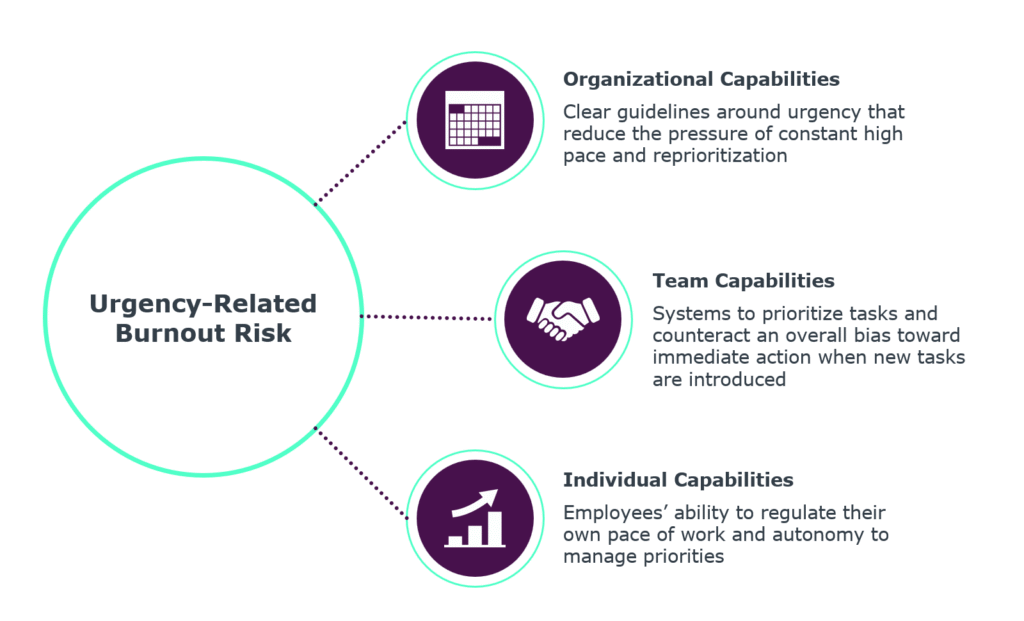
When these capabilities go unmanaged, the entire organization defaults to constant acceleration and immediate action, even when it undermines focus, quality, and sustainability.
Three Questions to Examine Each Urgency Phase
To build these capabilities, there are several questions that help us better understand where urgency breakdowns are causing long-term strain.
1. Individual Capabilities: What clarity do individuals need in order to use speed to their advantage?
What distinguishes high-performers is not that they move quickly everywhere but that they are deliberate about where speed truly matters. Regulating urgency is not about dampening that momentum but rather, it is about protecting speed for the moments where it delivers the most value.
This strategic speed depends on an individual’s ability to differentiate between decisions that are existential or time-critical and those that benefit from deeper analysis and coordination. When that distinction is missing, urgency becomes the default setting and we are forced to treat routine work with the same intensity with which we regard true crises, keeping the nervous system compressed in a constant state of activation. Over time, this choice depletes cognitive capacity and increases the likelihood of errors and rework, ironically slowing down the organization.
2. Team Capabilities: How are teams handling decisions through uncertainty?
Most team urgency is a decision-making problem, not a workload problem. When decision rights are unclear, team leaders hesitate to commit and work continues—but without clear direction. As a result, teams are asked to move quickly, only to be redirected later when alignment finally emerges.
Historically, managers served as regulators of this pace, translating strategy into realistic priorities and protecting teams from unnecessary escalation. However, today most managers are responsible for two assignments: functional expertise and people management, often without authority to reset expectations with executives or their teams. As a result, they are pressured to move fast from above while shielding their teams below, driving up manager burnout and employee distrust of their leaders.
From an HR perspective, this reframes urgency as an issue of governance. Burnout often escalates not because teams are doing too much work but because they are doing work that keeps getting undone. New research shows that the most resilient teams and leaders are able to better meet pace and workload expectations when decision-making authority and expectations are clear
3. Organizational Capabilities: Where are we generating unnecessary time pressure?
Too often, conversations about urgency land on individual coping strategies: time management, boundary setting, or resilience training. While these skills matter, they cannot compensate for systems that continuously generate artificial time pressure.
Urgency is produced structurally: through planning rhythms, performance expectations, incentive models, and increasingly, through technology and AI-enabled acceleration that outpaces workflow redesign. When these systems are misaligned, employees experience sustained time pressure regardless of their personal effectiveness.
In order to truly govern time pressure, organizations need workflows that create moments of recovery. Research shows that when employees are denied real opportunities to recover from urgency, fatigue and stress pile up, decision quality suffers, and burnout becomes a recurring cost. Especially now, with the sheer volume of pressures our workforce is facing, it’s clear that recovery is not a luxury or a wellness “extra.” It’s a core driver of results that HR leaders can no longer afford to ignore.
Sustainable Speed Requires Governance, Not Heroics
In conclusion, there is no doubt that many organizations are experiencing this anxiety-inducing moment in business. Changing economic reality and political policy are not new, but the rate of change is. In periods of technological and competitive acceleration, executive leaders face pressure to make faster strategic decisions, often normalizing an organization-wide sense of urgency. Given the recent disruption we have seen, it’s no surprise that leaders are panicking about competition, market share, tech adoption, innovation, and so much more.
To break the cycle of chronic urgency and reduce burnout risk, HR leaders should look beyond EAPs and focus on urgency-specific interventions.
The organizations that sustain high performance over time are not those that simply push harder or expect their people to operate in permanent overdrive. Instead, they’re the ones that are deliberate about when urgency is necessary and just as deliberate about when to stabilize and recover.
For HR leaders, this represents a critical opportunity. Rather than telling individuals to “work harder,” the evidence suggests organizational systems must embed recovery into work design so that speed can coexist with resilience and performance. By helping organizations define how urgency is set, regulated, and reinforced, HR can move from reacting to burnout to preventing it, while preserving the decisiveness and momentum today’s business environment demands.
Take the next step in tackling burnout at its source.
About the Author
