Inclusion programs have faced increased scrutiny over the past 18 months, and ERGs are no exception. While many of the core recommendations for building lower-risk employee groups still apply, organizations continue to reassess how these programs are structured and governed.
For some, this is because even “lower-risk” is too risky; for others, it’s an opportunity to rethink how employee groups operate and how they create value. Many organizations are shifting from ERGs designed primarily to support representation and belonging toward models more explicitly tied to workforce enablement, business capability building, and organizational outcomes.
In practice, organizations are taking a range of approaches, from restructuring governance models to experimenting with entirely new types of employee groups.
How Organizations Are Rethinking ERGs
Seramount works with hundreds of ERGs every year and fields questions on topics like this all the time. While every organization is approaching this differently, several patterns are starting to emerge. Here are just a few common trends:
ERGs are being renamed but not always redesigned:
Some organizations are removing explicit identity references from ERG names or broadening how groups are described externally. However, renaming an ERG without changing how the group operates often re-creates the same challenges under a different label.
ERG responsibilities are becoming more focused:
Organizations are reassessing what ERGs should realistically be responsible for. Over time, many groups have accumulated responsibilities well beyond their original purpose, leading some companies to narrow the scope of ERGs to a smaller set of sustainable priorities.
The expectations of ERG leaders are changing:
Organizations are placing greater emphasis on competencies such as business acumen, strategic planning, and cross-functional leadership when selecting and developing ERG leaders. Read more about it here.
New ERG models are being tested:
Some organizations are moving beyond traditional affinity-based ERGs altogether, particularly when it is difficult to prove impact or internally defend the existing models. These newer structures are often designed to broaden participation, create clearer alignment to business priorities, and reduce reliance on protected-class identity as the primary organizing principle.
Three Emerging ERG Models
While employee group structures can look very different from one organization to another, three alternative models are showing up more frequently as organizations rethink how ERGs are structured: experience-based groups, mission-based groups, and capability-based groups.
1. Experience-based communities
Experienced-based communities are organized around how employees experience work or the employee lifecycle. Examples include early-career employees, caregivers, working parents, remote or hybrid workers, employees navigating career transitions, or well-being and mental health groups.
These groups are often designed to help employees navigate common challenges, build internal networks, and access mentorship and development opportunities.
For example, at MGM Resorts, the company’s UNLV Alumni BRG focuses on supporting students and early-career talent as they transition from campus to career. Through mentorship, networking, shadow days, and career development programming, the group has helped strengthen MGM’s talent pipeline while giving employees and students clearer pathways for growth and advancement.
2. Mission-based communities
Mission-based communities align directly to enterprise priorities, such as innovation, product design, customer service experience, community impact, volunteerism, leadership development, or digital transformation, giving employees a way to contribute directly to enterprise goals while still building connection across functions and teams.
Because they are tied to organizational priorities, these groups often evolve as business needs change.
At SEI Investments, for example, the company launched an innovation-focused ERG called SEIsmic after identifying a lack of scalable employee-driven innovation programs. The group crowdsourced ideas tied to four business priorities, built a coaching and evaluation infrastructure, and engaged cross-functional leaders to advance the strongest concepts. The initiative reportedly doubled ERG engagement while generating more than 200 ideas across the business.
3. Capability-based communities
Capability-based communities build critical skills the organization needs in order to stay competitive, such as business acumen, inclusive or universal design, commercial capability, research and innovation, AI fluency, or future-leader readiness.
At Liberty IT, the company’s STEM-focused employee group launched “STEAM Studio,” a coding and digital skills initiative designed to address STEM engagement gaps in Northern Ireland. Employee ambassadors partnered with schools and museums to deliver workshops, mentorship, and technical support to more than 1,500 students, while also helping employees build leadership and coaching capabilities internally.
Looking for more examples of impactful ERG programs?
While many organizations are reassessing ERGs through a risk lens, the broader shift has been underway for much longer. Increasingly, companies are moving from activity-driven ERG models toward systems that are more clearly aligned to workforce needs, business priorities, and measurable impact.
What that looks like will vary from organization to organization. For some, it may mean refining governance and leadership expectations; for others, it may involve experimenting with entirely new types of employee groups. Tools such as SEGMA (Seramount Employee Group Maturity Assessment) can help organizations evaluate where their ERG programs stand today and identify where change may be needed.
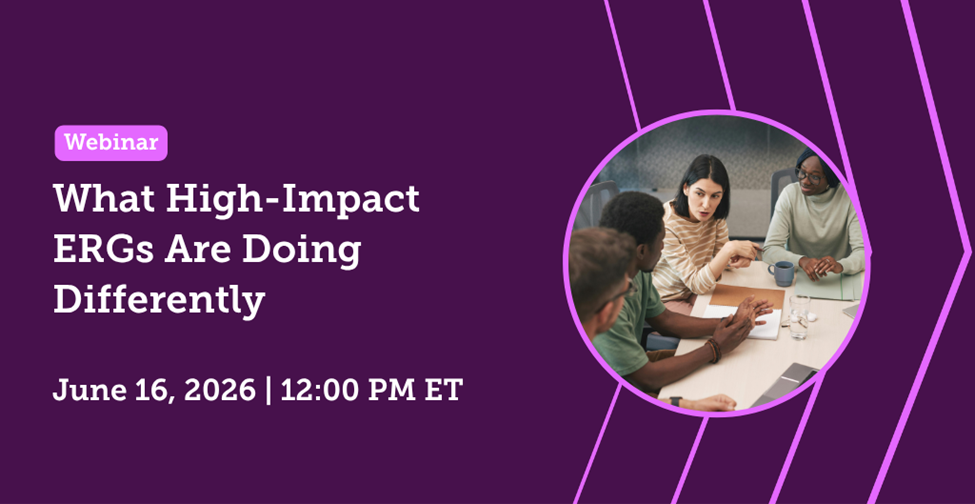
Interested in hearing more ERG best practices? Join our upcoming webinar for a look at what high-performing ERGs are doing today.
Kayla Haskins is an Associate Director, Product Marketing at Seramount. In this role, she supports DEI Practitioners and Talent Leaders in creating more inclusive workplaces by providing valuable insights and resources through webinars, blog posts, guides, infographics, and more.
With nearly a decade of experience in the technology and non-profit sectors,
Kayla Haskins is an Associate Director, Product Marketing at Seramount. In this role, she supports DEI Practitioners and Talent Leaders in creating more inclusive workplaces by providing valuable insights and resources through webinars, blog posts, guides, infographics, and more.
With nearly a decade of experience in the technology and non-profit sectors, Kayla excels in translating complex ideas into clear, actionable concepts. She is passionate about storytelling and is dedicated to addressing today’s most pressing workplace issues to drive meaningful impact.
Kayla holds a degree in English and Creative Writing from Dickinson College. She lives in Silver Spring, MD with her partner, Nick, and their dog, Zero. In her free time, she enjoys hiking, reading, and spending time with family and friends.