We came to the same problem from different directions.
When Stephanie taught writing at Carnegie Mellon University, students often treated a polished final essay as proof that their thinking was finished. Fifteen years in higher education taught her otherwise: Polish could conceal weak reasoning just as easily as it could reflect strong thinking. The real value was in revision: defending an argument, analyzing evidence, challenging assumptions, and deciding what deserved to stay.
Alison came to a parallel conclusion through years of work in strategic planning and business analytics in tech and finance: Employees can remain highly active and look visibly productive, even as their capacity for focused, strategic work is eroding.
Research that Alison Campbell conducted with Danielle Hartigan of Bentley University’s Center for Health and Business examined 544 professionals across 15 industries. The largest employee profile category was titled “overextended”: high visible activity, low innovation capacity, and high burnout. These employees were 2.4 times as likely as their high-activity, high-capacity peers to report avoiding complex tasks and struggling with high-quality, focused work.
Both of those groups can look busy and productive. What differs is their capacity for the work that becomes more valuable as AI makes output easier to produce: questioning assumptions, exercising judgment, and thinking strategically—components of the same discipline Stephanie spent years teaching students.
That is where our perspectives converged: AI is making output easier at the same moment when organizations need to protect the human capacity to question that output. Here’s the catch: Judgment may be a skill that is developed in individual employees, but the conditions for exercising it are determined by cultural influences and norms.
Saved time is not the same as created capacity
AI can genuinely save time. Among frontline employees who regularly use AI, BCG found that 42% saved at least eight hours per week. However, 66% received limited or no guidance on what to do with that saved time, and more than half did not redirect it toward more strategic work.
We know that AI can accelerate work downstream. What we’re learning now is that speed in one part of the organization can become volume in another.
One employee may gain hours to invest in higher-value work. Another may have those hours immediately backfilled with additional demands. A third may absorb responsibility for the review, coordination, or judgment that makes someone else’s efficiency possible.
On a productivity dashboard, all three can look like the same success. But that dashboard cannot answer the harder question: capacity for what?
Leaders are doubling down on AI investment, but right now, they need to be just as deliberate about the human conditions around it by asking:
Does my organization reward responsiveness or reflection?
Whose judgment is trusted enough to challenge an apparently finished answer?
When AI frees time, who gets a harder problem, a visible assignment, or room to learn, and who simply gets more work?
If you’re a leader and you can’t answer those questions, you might be widening the gap between who benefits from AI and who bears the work behind it.
Culture decides who gets the upside
Mainstream discussion surrounding AI’s promise often overlooks a harsh reality: Employees do not work in neutral environments. Workplace systems teach people what is expected, rewarded, risky, and possible. Those repeated signals become culture—what employees turn to in times of ambiguity or doubt.
Leaders may tell employees to experiment with AI, but culture determines what happens after someone questions an AI-generated recommendation, admits they do not trust an output, or uses saved time to explore an idea instead of merely producing more of the same. Your organization’s culture will actually be shaped by what happens next.
Seramount’s recent analysis of more than 10,000 employee responses found that only 41% feel comfortable taking risks. That matters for AI-enabled work, which increasingly asks employees to question outputs, admit uncertainty, and challenge decisions.
Who gets access to the opportunities AI creates?
Opportunity is uneven too. Employees with sponsors are more than nine times as likely to have a high-impact network and more than four times as likely to believe they will advance to a senior role. Yet 56% of women of color report having no sponsor, the highest share of any group in the analysis.
These are not AI metrics. They reveal who is positioned to exercise judgment and turn new capability into opportunity.
Three employees can become more capable with AI and encounter very different futures. One gets the stretch assignment, visibility, or sponsorship. Another simply gets more work done. A third becomes the person who checks and edits the results so that everyone else can move faster.
In knowledge work, even that can be surprisingly difficult to measure. Faster production may create more review, coordination, iteration, or downstream work elsewhere. And even when AI does free time, leaders need to address the open question—where and how should that saved time be moved to next?
So, if you’re serious about deploying AI to achieve your business outcomes and evolve your business, ask harder questions:
What did AI remove?
What did it create?
Who absorbed the difference, and who gained an advantage in the process?
Underneath all three of those questions is a culture question: What are we making rational?
If saved time always produces another assignment, employees learn that efficiency means more volume. If questioning AI carries risk, silence becomes logical. If new capability creates opportunity only for employees who already have visibility or sponsorship, existing differences compound.
A productivity gain is incomplete information until leaders know where the work went, whose judgment made it possible, and who benefited.
AI is changing the work. Who gets the upside?
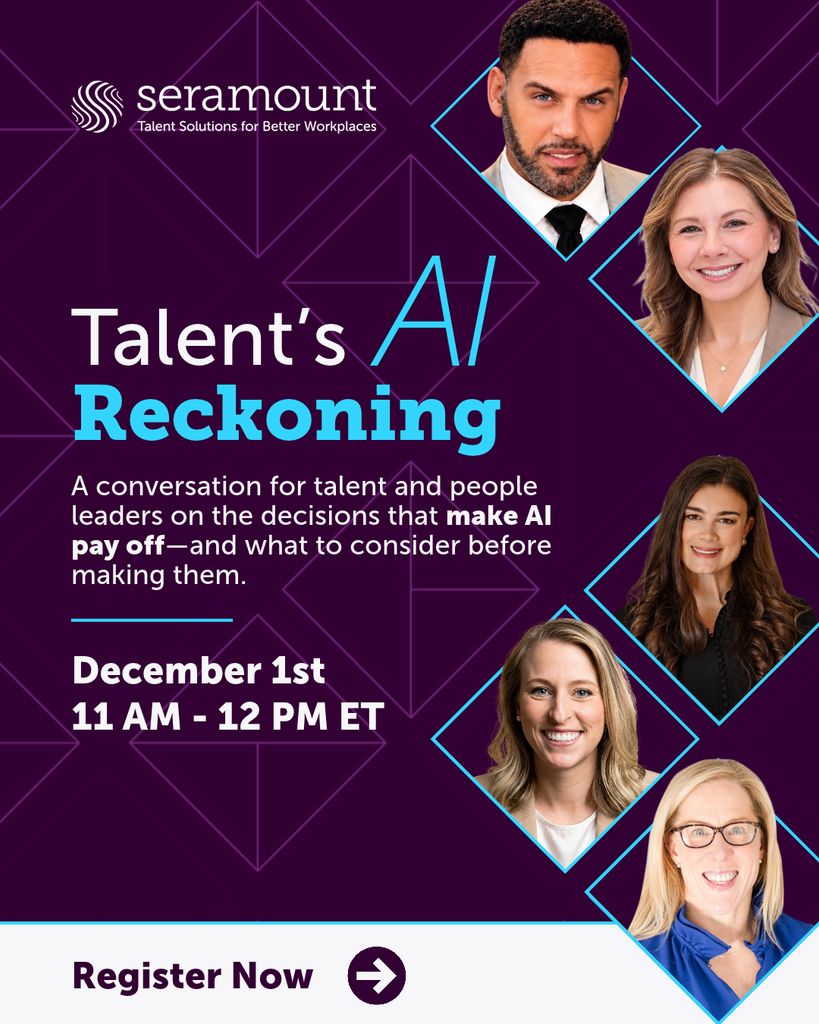
Join leading industry experts on December 1 for Talent’s AI Reckoning to explore what new research from 10,000+ employee responses reveal what’s at stake for work, skills, and opportunity in 2027.
Stephanie Larson is Principal, Market Insights at Seramount, where she translates research, market signals, and executive perspectives into clear points of view on AI, workforce transformation, talent, inclusion, and the future of work.
Stephanie Larson is Principal, Market Insights at Seramount, where she translates research, market signals, and executive perspectives into clear points of view on AI, workforce transformation, talent, inclusion, and the future of work. Her work identifies emerging shifts in work and talent, connects them to the business questions senior leaders are facing, and develops Seramount’s market-facing point of view by leading the firm’s thought leadership.
Before joining Seramount, Stephanie spent 15 years in higher education, most recently as an Associate Professor of English and Gender Studies at Carnegie Mellon University. Her background in organizational cultures, gender, and labor informs the distinctive lens she brings to workforce transformation today. She is the author of two books and numerous academic publications. Stephanie holds a BA in English Education from the University of Illinois and an MA in English Literature and PhD in Writing & Rhetoric from the University of Wisconsin-Madison.
Stephanie lives in Madison, WI, with her husband and two children. Outside of work, she can be found hiking through the woods, planning her family’s next road trip, or reading her latest book-club pick.
Alison Campbell is the founder of unBurnt, a research backed organizational capacity practice focused on AI transformation, burnout, and leadership sustainability.
Her work helps organizations understand the cognitive and strategic bandwidth required to turn effort, ideas, and new technology into sustained value.
Alison Campbell is the founder of unBurnt, a research backed organizational capacity practice focused on AI transformation, burnout, and leadership sustainability.
Her work helps organizations understand the cognitive and strategic bandwidth required to turn effort, ideas, and new technology into sustained value. Before founding unBurnt, Campbell served as Vice President of Strategic Planning & Head of Business Analytics at Workhuman.