3 Ways to Lead Through AI Uncertainty Without Losing Employee Trust



Scan the headlines, new-hire messages, and CEO talk tracks and you will hear a familiar refrain: use AI to move faster, expand what you can do, and, ultimately, create more capacity.
It is an optimistic message. But employees might hear something else: capacity for what? If AI gives employees more time, will organizations use it to improve work and build something new or will they decide they need fewer people?
Leaders know the answer is unsettled. In RSM’s 2026 survey of more than 1,000 business leaders, 85% agreed that executive leadership is more enthusiastic about AI than employees are. Meanwhile, 88% expect the size and composition of their workforce to look fundamentally different within the next two to three years because of AI.
One senior executive I interviewed for new Seramount research described the bind this way:
We are getting paid for certainty. We’re getting paid for direction. We’re getting paid for setting the course.” Yet as AI changes faster than leaders can plan for it, they note, “It becomes really hard to say, ‘I don’t know how to set this course.”
AI is forcing leaders to move before the picture is complete. When executive confidence gets too far ahead of what employees can see and experience, enthusiasm can start to feel like pressure.
Over the summer, I interviewed senior leaders about what companies need to do in order to turn AI experiments into measurable business results. I paired those conversations with analysis of more than 10,000 qualitative and quantitative responses from Seramount’s Employee Voice Sessions, drawn from a broader dataset of more than 2 million employee data points.
What emerged was a leadership approach I think of as principled uncertainty: Be precise about what you know, honest about what you do not, and concrete about what employees can expect next.
1. Say what you know
Imagine being told that AI should make you dramatically more productive while your performance expectations still describe the old job. You automate part of a weekly deliverable. The work gets faster, but then what? Are you expected to produce more? Spend more time checking the output? Use that capacity to learn something new?
One thing leaders already know is that requisite job skills are changing. Lightcast reports that the average U.S. job has seen nearly one-third of its required skills change in just three years. In the most AI-exposed jobs, PwC finds that skills are changing more than twice as fast as in the least AI-exposed roles.
That makes it more urgent to tell employees what good performance looks like today.
In Seramount’s Employee Voice Sessions, only 32% of employees said they understand what it takes to succeed in their organization. AI did not create that lack of understanding. But changing the work without updating expectations makes the problem more consequential.
Daisy Auger-Domínguez, Chief People Officer at Digital Asset, shared that what teams need is “directional clarity.” Her experience shows how quickly unclear AI expectations can become a job-architecture problem.
Her team had just launched a new job architecture when Daisy realized something was missing: None of the criteria they had defined by level included AI capability. Suddenly they had to ask: “What does AI capability look like at a level one versus a level nine and ten?”
Candidly, she explained that the answer to that question was unknown: “We don’t even have that knowledge base.” Yet, the architecture still needed to reflect the new work.
If AI changes the work, the systems that define good work must catch up. Although leaders may not know exactly where AI will take a job, employees need to know what the organization expects from them today.
2. Say what you don’t know
Clarifying what is known is only half the job. Leaders also need to acknowledge that many questions still linger without answers and employees doing the work are still discovering some of those answers.
Gina Greenwalt, who leads culture, people development, and people analytics at Twitch, describes this as AI’s “messy middle.” Even senior leaders, she told me, are learning from employees’ experimentation closer to the work. That reality has changed how her L&D team operates.
Rather than assuming HR should have all the answers, the team leans on employees who experiment with AI in their own jobs—employees whom she calls “AI pioneers”—to identify practices that work and then bring colleagues along. L&D helps those practitioners turn what they are learning into practices others can use.
“We’re not in the front of the room,” Gina said. “That’s really different for us.” That model requires humility. Expertise does not necessarily sit with the most senior person in the room. Organizations must be able to learn from the people who have the expertise in order to get to the next step of transformation.
That is why employees need to feel safe raising concerns. According to Seramount’s Employee Voice Sessions, only 41% of employees are not afraid to take risks. Among employees who explained why they stayed silent about an issue, 54% cited fear of retaliation, and 38% believed speaking up would not make a difference.
Gina told me that leadership can sometimes experience AI transformation as a “no-brainer.” However, for the people actually doing the work, she said, “It shouldn’t be a no-brainer.” To create value with AI, organizations need employees to think critically.
That is the second discipline: keep open the opportunity to ask questions. Acknowledging uncertainty makes room for employees to tell leaders what they may be missing. If employees stop expressing their concerns and observations, uncertainty has not disappeared. Rather, leadership has simply lost access to information about it.
3. Say what happens next
Clarity and candor can create trust. Then leaders must give employees something they can do with that trust.
Leaders can credibly ask employees to experiment, learn, and build new capabilities after leaders clarify what is changing and what remains unknown. But leaders also must share that responsibility.
In my conversation with former Johnson & Johnson CHRO Peter Fasolo, he kept returning to “workforce competitiveness.” Organizations need to understand the capabilities they will require, help employees see where they stand, and give them ways to close the gap. He also drew an important distinction between AI literacy and AI fluency: applying the technology in the workflows, collaboration, and decisions that create business value.
That changes the AI equation.
Organizations can reasonably ask employees to learn, experiment, and take more ownership of their development. Employees are investing time and effort. They are learning new ways of working without knowing exactly where those changes will take their jobs. Organizations must support that learning.
IBM offers one example. Even as AI takes on work historically performed by junior employees, the company plans to triple U.S. entry-level hiring in 2026. IBM has described redesigning those roles so that junior developers spend less time on routine coding and more time with clients, while entry-level HR employees increasingly handle exceptions that automated systems cannot resolve.
IBM’s approach will not fit every organization. But it asks the right question: If we are asking employees to adapt, what are we giving them to adapt toward?
The third discipline is, thus, to give employees a clear way to act. Leaders cannot promise that every job will remain intact. However, they can give employees something more useful than reassurance: a credible way to move forward.
The norms are being set now
Responding to uncertainty with a disciplined approach gives leaders a practical way to keep an organization moving when certainty is unavailable. And the stakes extend beyond this transition.
Colby Kennedy Nesbitt, a people analytics leader at Netflix, told me it is easy for HR leaders to treat AI as an inevitability. But treating AI as an inevitability underestimates the influence HR leaders and employees still have over “the norms of what’s acceptable.” Nesbitt said, “We’re shaping that right now.”
As access to AI tools becomes more widespread, the technology itself may become less of a differentiator. Colby argues that the advantage will increasingly come from what is particular to an organization: its institutional knowledge, its ideas and creativity, and its people’s ability to use the technology. That insight should change how people leaders see this moment.
AI is changing work and forcing organizations to decide what they will reward, protect, teach, automate, and leave to human judgment. Organizations need to shape these choices deliberately.
Our new Seramount research examines what helps AI experiments create lasting value and where existing talent and culture systems are already under strain.
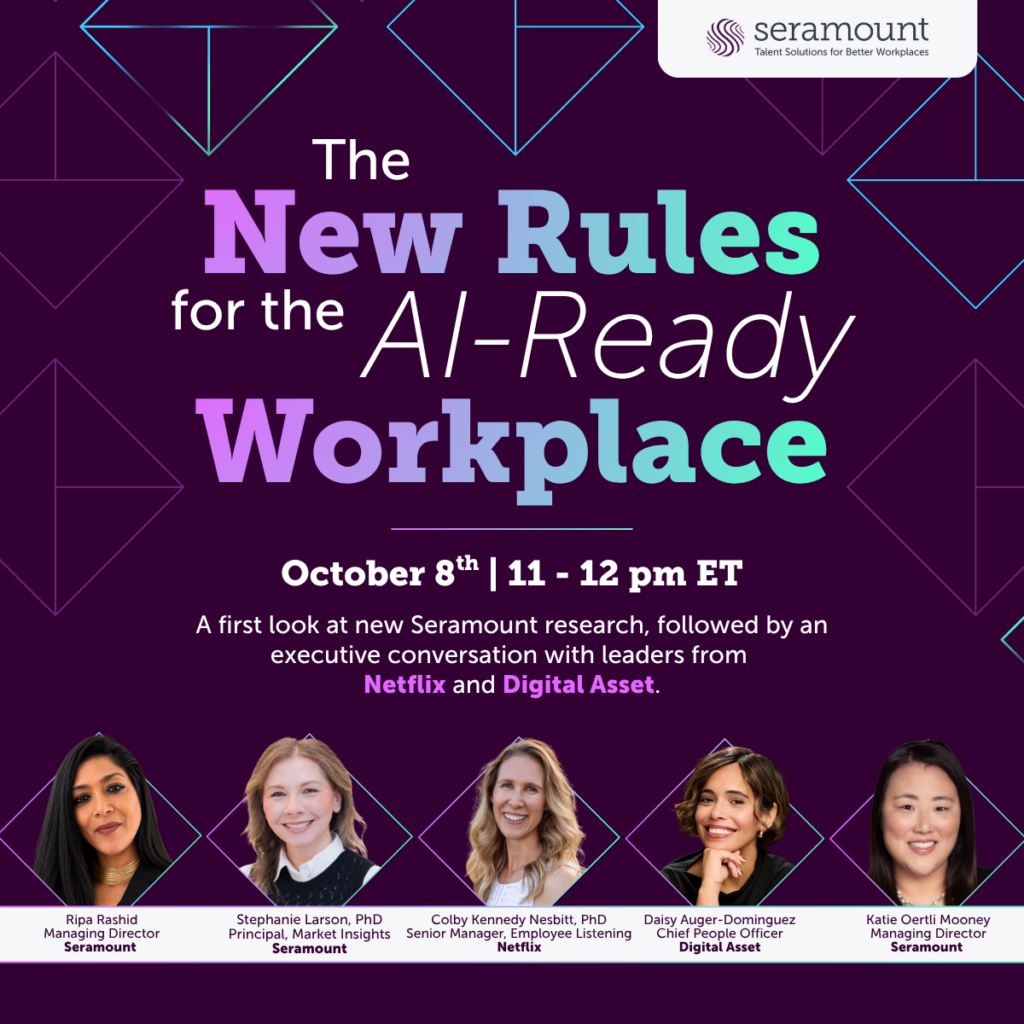
On October 8, we’ll discuss those findings with leaders making these decisions in real time and ask the harder question this article leaves unspoken: What should people leaders be doing now, before today’s AI experiments harden into tomorrow’s ways of working?