Spend any time on social media and it is clear that the skilled trades are having a moment. Videos showcasing tangible work, strong earning potential, and job security have helped recast careers young people were once encouraged to overlook. Yet interest has not yet produced a wave of young workers: While research shows 38 percent of high school students were considering the trades, only 11 percent planned to pursue them after graduation.
Employers need that interest to become something more. More than one in four skilled trade workers is 55 or older, leaving industries that already depend on difficult-to-replace expertise with a growing need to attract and prepare the next generation.
Gen Z’s interest gives employers an opening, but not yet a reliable talent pipeline. To capitalize on this interest, employers must help the next generation of talent move from a general impression of “the trades” to a realistic understanding of particular jobs, workplaces, and career paths.
Why Gen Z Interest in Skilled Trades Isn’t Yet a Talent Pipeline
Being interested in “the trades” is one thing; knowing which job might actually be a good fit is another. Several gaps stand between general interest and an informed career decision:
Research identified substantial gaps between students’ aptitudes and their interest in certain fields. For example, the analysis found that 18 percent of students demonstrated aptitude but no reported interest in advanced manufacturing, with the same gap in transportation, distribution, and logistics. In architecture and construction, the gap was smaller, but still showed a 12 percent difference. This suggests many young people may be overlooking work they could be well suited to do.
Broad perceptions can overshadow the differences between jobs.
Forty-three percent of Gen Z respondents identified physical labor as their primary concern about the trades. Those demands should not be minimized, but they also vary considerably by occupation and workplace. Job seekers need enough clarity to evaluate the reality of a particular job rather than reacting to a generalized image of trade work.
The long-term career path is unclear.
Nearly half of students believed that growth opportunities in the trades were limited. Employers need to show not only the first job but also where it can lead over time.
Show Gen Z What the Work Is Really Like
The next generation of talent is looking for more than a general pitch about the trades. In one study, 69 percent of high school students preferred messaging that provided concrete details about the career path. Employers can go a step further by letting potential candidates experience aspects of the work for themselves.
Forage job simulations allow employers to introduce their roles to potential candidates earlier in their career exploration. Job seekers complete tasks modeled on real work at a particular company, helping them answer questions a traditional job description rarely addresses:
What would I actually do in this role?
What skills would I use?
Would I enjoy solving these kinds of problems?
Can I see myself working here?
Internships and site visits can bring a career to life, but they reach only so many people. Through Forage’s self-paced, open-access simulations and network of nearly 10 million students, employers can bring that experience to a much broader pool of talent, building stronger pipelines of candidates who understand the opportunity and are interested in exploring it further.
GE Aerospace’s Explore Manufacturing Engineering simulation shows what this experience can look like. Participants step into the role of a supply chain engineer and complete work based on what GE teams do in manufacturing shops. They use engineering data and drawings to determine the requirements for a turbofan disassembly fixture and decide how to address nonconforming turbine blades.
As experienced workers retire, employers need to start building the next generation of their workforce now. At the same time, unemployment among 20- to 24-year-olds was 8 percent in September 2026, nearly twice the overall rate of 4.2 percent. Employers need talent, and many young people are struggling to get started. The missing piece is often a clear way to connect the two.
Forage can help bridge that gap. By giving the next generation of talent a realistic look at the work before they apply, employers can build a stronger pipeline of candidates who know what the job involves and are prepared to pursue it.
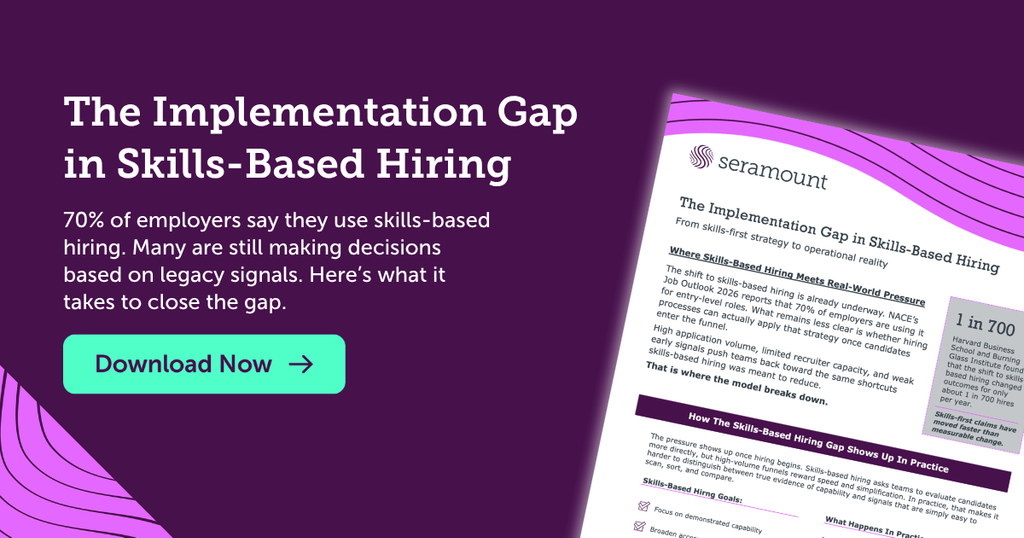
Want to turn a broader pool of talent into better hires? DownloadThe Implementation Gap in Skills-Based Hiringto learn what prevents skills-first strategies from translating into practice.
Kayla Haskins is an Associate Director, Product Marketing at Seramount. In this role, she supports DEI Practitioners and Talent Leaders in creating more inclusive workplaces by providing valuable insights and resources through webinars, blog posts, guides, infographics, and more.
With nearly a decade of experience in the technology and non-profit sectors,
Kayla Haskins is an Associate Director, Product Marketing at Seramount. In this role, she supports DEI Practitioners and Talent Leaders in creating more inclusive workplaces by providing valuable insights and resources through webinars, blog posts, guides, infographics, and more.
With nearly a decade of experience in the technology and non-profit sectors, Kayla excels in translating complex ideas into clear, actionable concepts. She is passionate about storytelling and is dedicated to addressing today’s most pressing workplace issues to drive meaningful impact.
Kayla holds a degree in English and Creative Writing from Dickinson College. She lives in Silver Spring, MD with her partner, Nick, and their dog, Zero. In her free time, she enjoys hiking, reading, and spending time with family and friends.