AI is already embedded in recruiting, and inclusion leaders have good reason to pay attention. Recruiters are under real pressure to manage volume. Already, 72% of hiring managers said they worry that strong candidates are getting lost in the volume of applicants they receive, while one in five said application volume is challenging or overwhelming.
At the same time, research suggests those efficiency gains can come with real equity risks. AI resume-screening tools have rated older male candidates more favorably than equally qualified women and younger candidates, and researchers found that 26% of Black applicants and 15% of Asian applicants applied to jobs where an AI screening system discriminated against their racial group.
Recruiting is the front door to an inclusive organization. Every effort to build diverse leadership pipelines, improve representation, or create a more inclusive culture starts with who gets hired. If bias enters the hiring process at the earliest stages, equitable outcomes become much harder to achieve.
That is why inclusion leaders need to understand not just whether AI is being used but also how it is shaping decisions.
Finding the Right Role for AI in Recruiting
Not every use of AI carries the same level of risk. Using AI to schedule interviews is very different from using it to rank candidates. Using AI to summarize interview notes is different from asking it to recommend who should be hired. Yet too often, these very different use cases get lumped together under the same conversation.
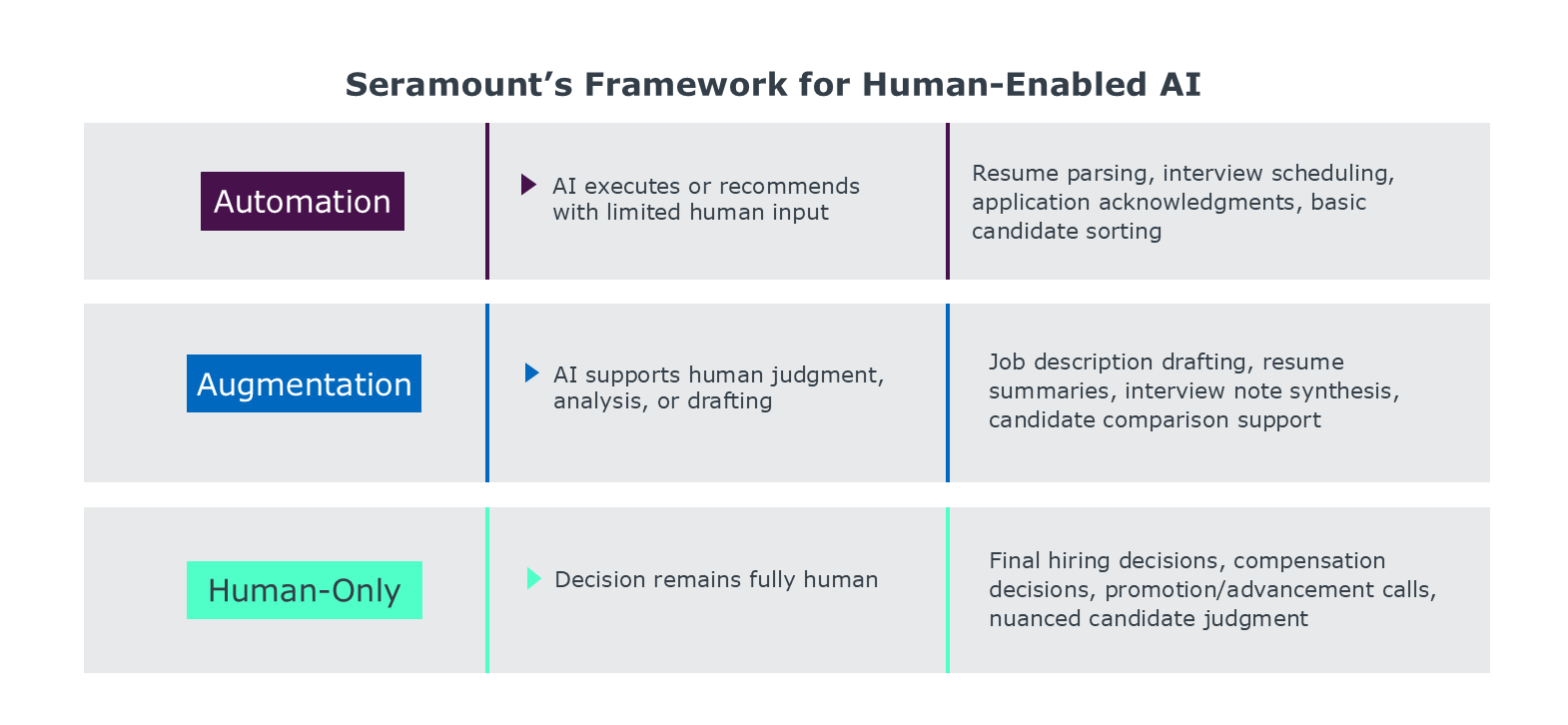
That is why Seramount uses a simple framework to think about AI in any task: automation, augmentation, and human-only decisions.
Automation is when AI completes a task or makes a recommendation with little human involvement.
Augmentation is when AI helps people make better decisions but doesn’t replace their judgment.
Human-only decisions are the moments where people—not algorithms—should make the final call.
The key point is that these are not ranked from safest to riskiest. A well-governed automated step can be more equitable than an unstructured human decision, and an unchecked manager can do just as much harm as a biased model. What matters is the role AI plays in the decision; that is the lens inclusion leaders need right now.
It can be helpful to apply this framework to talent acquisition efforts. A good place to start is by looking at common recruiting practices and asking where each one really belongs. Some tasks may be appropriate for automation, others may work best as augmentation, and some should remain firmly human-only. That is not an accusatory exercise; it is a practical way to level set and see whether the current process matches the intended one.
Once inclusion leaders have that visibility, it becomes much easier to spot where AI may be stepping too far, where human judgment may be too loose, and where a small adjustment could make the process more equitable.
Three Practices Inclusive Recruiting Still Requires
AI is here to stay in recruiting, but it has not changed the need for inclusive recruiting practices. In fact, some of the fundamentals inclusion leaders have relied on for years may matter even more in an AI-enabled process.
1. Revisit job requirements to support skills-based hiring.
One of the clearest ways to reduce bias in a recruiting process is to focus on the skills and experiences that actually matter for the role. AI can help recruiters move beyond pedigree, degree requirements, and other proxy signals that often shape hiring decisions in ways that disadvantage candidates by age, education, or background.
That is one reason skills-based hiring has gained momentum in recent years: It can broaden the talent pool while improving performance. In fact, employees hired for skills over pedigree are 1.9 times more likely to perform effectively. For inclusion leaders, that makes skills-based hiring a practical way to use AI in support of broader access, not narrower screens.
2. Standardize hiring-manager conversations and interviews.
If AI is helping surface candidates, the human part of the process needs to be structured enough to stay fair. That means using consistent interview guides, clear criteria, and standardized feedback tools that keep hiring-manager judgment anchored in the same expectations for every candidate.
Without that structure, bias can reenter the process at the exact moment organizations assume the hardest work has already been done. Standardization helps prevent “human-only” decisions from becoming unstructured decisions, which is where inequity often creeps back in.
3. Track recruiting data to spot issues early.
The fastest way to miss AI bias is not to look for it. Inclusion leaders need visibility into hiring data by role, level, team, and stage of the process so they can spot patterns before they harden into habits. Are certain groups dropping out at a particular stage? Are some hiring managers or job families producing consistently different outcomes? Are there gaps in advancement, compensation, or representation that point to a deeper process issue?
The sooner those patterns are surfaced, the sooner organizations can add more human review, change tools, or adjust the process before bias becomes embedded.
AI is here to stay in recruiting, and inclusion leaders cannot afford to treat it as a temporary trend. The real challenge is making sure hiring systems are designed to use AI responsibly so that efficiency does not come at the expense of fairness.
Even as new challenges emerge, many of the playbooks inclusion leaders already use still hold true. The difference now is that they need to be applied with fresh context, new guardrails, and a sharper understanding of how AI is changing the recruiting process.
If you are looking to strengthen your approach, Seramount’s inclusive talent lifecycle guide can help you think through the full talent process with inclusion in mind.
Kayla Haskins is an Associate Director, Product Marketing at Seramount. In this role, she supports DEI Practitioners and Talent Leaders in creating more inclusive workplaces by providing valuable insights and resources through webinars, blog posts, guides, infographics, and more.
With nearly a decade of experience in the technology and non-profit sectors,
Kayla Haskins is an Associate Director, Product Marketing at Seramount. In this role, she supports DEI Practitioners and Talent Leaders in creating more inclusive workplaces by providing valuable insights and resources through webinars, blog posts, guides, infographics, and more.
With nearly a decade of experience in the technology and non-profit sectors, Kayla excels in translating complex ideas into clear, actionable concepts. She is passionate about storytelling and is dedicated to addressing today’s most pressing workplace issues to drive meaningful impact.
Kayla holds a degree in English and Creative Writing from Dickinson College. She lives in Silver Spring, MD with her partner, Nick, and their dog, Zero. In her free time, she enjoys hiking, reading, and spending time with family and friends.